





Jovan Dučić was born on February 17, 1871, in a village near Trebinje. His father Andrija died in the Herzegovinian Uprising a year after Jovan’s birth. Jovan had an older sister, as well as a half-sister and half-brother whom he got when his mother Jovanka remarried.
He completed elementary school in Trebinje, and in Mostar he finished trade school. He attended teacher training school from 1890 to 1891 in Sarajevo, and in 1893 he graduated in Sombor.
In the same year, he got a job as a teacher in Bijeljina, however, he did not stay long in this position because the authorities first put him under investigation and then expelled him from the city due to his patriotic poems “Otadžbina” (Fatherland) and “Oj, Bosno” (Oh, Bosnia).
He was forbidden to work as a teacher in Serbian schools in Bosnia and Herzegovina, but he still managed to get a job in an Orthodox school at the Žitomislić Monastery. The authorities found out about this as well, and Dučić then decided that he would no longer work as a teacher.
His exile from Mostar also affected his relationship with his former student from the trade school, Magdalena Nikolić. Namely, their secret engagement was broken off by Dučić’s expulsion.
They corresponded after their separation, and allegedly Magdalena decided never to leave her house again. She asked for it to be engraved on her monument that she was also a poet and the first inspiration of Jovan Dučić.
The poem “Samohrana majka” (Single Mother) was Dučić’s first poem, and he published it in 1886 in the newspaper “Golub” (The Pigeon). The newspapers “Neven” (Marigold), “Cetinjske Zore” (Dawns of Cetinje), “Bosanske Vile” (Bosnian Fairies) published his poems, and he also began to write nationalist articles and essays.
After being banned from teaching, Dučić, together with Aleksa Šantić and Svetozar Ćorović, founded the literary magazine “Zora” (Dawn), where he was the editor-in-chief. He published translations from German and French, as well as essays and discussions about books, paintings, and current world events.
In the newspaper “Zora” in 1901, he published his first collection of poems, but he and Ćorović were fired and arrested, and after being released from detention, he enrolled in law studies in Geneva.
In the early autumn of 1904, his drama “Krunisanje Dušanovo” (The Coronation of Dušan) was performed at the National Theatre.

Diplomatic career
In 1907, he became a clerk in the Ministry of Foreign Affairs of Serbia, and three years later he was appointed attaché in Constantinople, and then in Sofia.
In the period from 1912 to 1927, he built his diplomatic career in Rome, Athens, Madrid, Cairo, and he was also a delegate to the League of Nations in Geneva.
Due to the so-called “Geneva affair,” he was temporarily retired for two years. According to reports, Dučić became friends with the Vogel family in Geneva, such a good friend that he was considered a member of their family. Mrs. Vogel accused him of being the father of the child her daughter Antoinette gave birth to and threatened legal action if he did not acknowledge paternity.
It turned out that Dučić could not be the father of the child because he spent five months at the Vogel’s house, during which time Antoinette had already given birth. However, this accusation echoed around the world, and as all the newspapers wrote about it, it negatively affected Dučić’s diplomatic career.
After a two-year break, he was reinstated as the chargé d’affaires in Egypt. He soon became a corresponding member of the Serbian Royal Academy, and in 1931 a regular member.
He continued his diplomatic career in Budapest, Rome, Bucharest, and then was transferred to Madrid. He would remain there until the Kingdom of Yugoslavia severed diplomatic relations with Spain after its recognition of the Independent State of Croatia.
During his diplomatic career, he wrote travelogues and letters, and among his essays, the one about Bora Stanković stands out, as well as the work “Blago cara Radovana” (The Treasure of Emperor Radovan). Critics rated his poems as almost perfect, yet written in simple language and understandable to everyone.
The two basic motifs of his poetry were nature and love, and his poetry exuded melancholy and a sense of transience, mourning, and a gloomy mood.
Some of his most beautiful poems were created in the cycles “Jutarnje pesme” (Morning Songs), “Sunčane pesme” (Sunny Songs), “Pesme ljubavi i smrti” (Songs of Love and Death), “Večernje pesme” (Evening Songs).
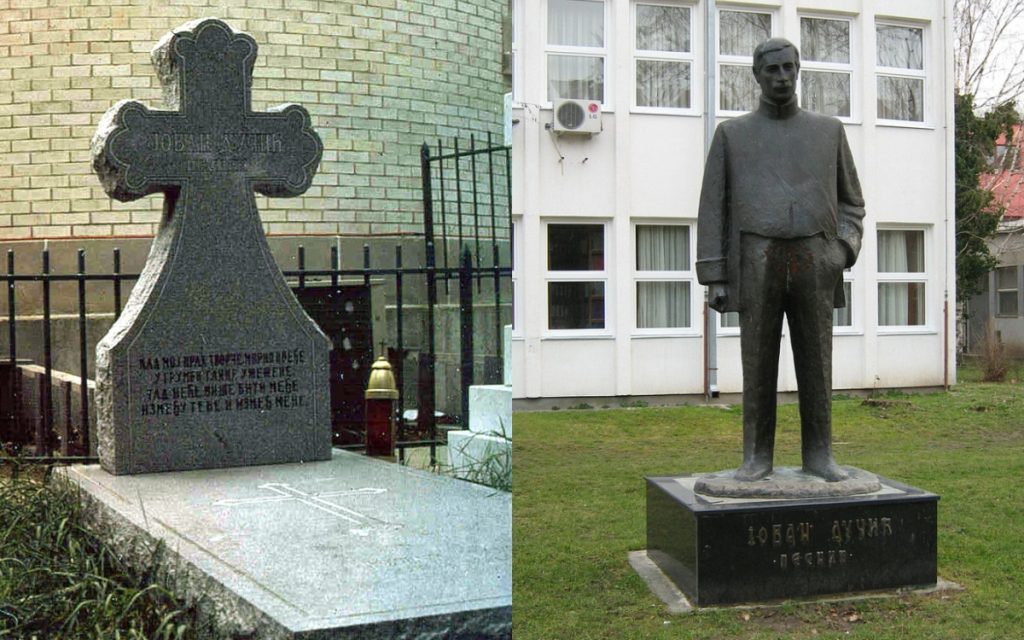
From Spain, Dučić moved to the United States, where he lived with his relative Mihajlo in the town of Gary, Indiana. He died there on April 7, 1943, from pneumonia, and his remains were transferred to the courtyard of the Saint Sava Monastery in Libertyville.
His last wish was to be buried in Trebinje, which was fulfilled on October 22, 2000. In his honor, the “Jovan Dučić” poetry award is given annually in Trebinje during the “Dučić’s Evenings” event.
MORE TOPICS:
THE SERBIAN CRADLE IN KOSOVO DOES NOT STOP ROCKING: Eight babies born in Pasjane! (VIDEO)
Source: Danas;Photo: Wikimedia Creative Commons
 Add Serbian Times as your Google source